

Most guides on citations read like a homework assignment: submit your business to 100 directories, keep your NAP consistent, and hope Google notices. That advice was mostly right in 2015.
In 2026 it’s a great way to waste a weekend on listings no one indexes, no one visits, and Google barely trusts.
Citations still matter for local business SEO — they’ve actually gotten more important for one big reason we’ll get into. But the game has changed. The right 20 citations, built the right way, will move your rankings. The wrong 200 will do almost nothing.
This guide is the exact process we use for local clients: what a citation really is, which ones move the needle, an industry-by-industry cheat sheet, the aggregators that feed everything else, and the audit-and-cleanup workflow that fixes the citations you already have (which is usually where the fastest wins live).
What a Local Citation Actually Is
A local citation is any mention of your business’s core contact information — Name, Address, and Phone number, or NAP — anywhere on the web. Sometimes it includes a link back to your site, sometimes it doesn’t. Both count.
Citations fall into two buckets:
- Structured citations are formal business listings on directories like Google Business Profile, Yelp, Apple Business Connect, Bing Places, Yellow Pages, or an industry directory like Avvo or Healthgrades. Everything sits in standardized fields.
- Unstructured citations are organic mentions in blog posts, news articles, press releases, event pages, “best of” roundups, forum threads, or podcast show notes. No form fields — just your business name showing up in real content.
For years, the SEO world obsessed over structured citations. That’s shifting.
According to Whitespark’s 2026 Local Search Ranking Factors survey, which polled 47 local search experts across 187 ranking factors, three of the top five AI Search visibility factors are citation-related, and unstructured citations now outweigh structured ones for AI search — the #4 AI visibility factor is literally “Quality/Authority of Unstructured Citations.”
Why Citations Are Suddenly More Important Again
For most of the last decade, citations have been slowly losing weight as a traditional ranking signal. Whitespark’s data shows they lost another half a point of weighting in the local pack/Maps group in 2026.
So why bother?
Because AI search — the answers that show up in Google’s AI Overviews, ChatGPT, Perplexity, Gemini, and Copilot — leans heavily on citations to decide which local business to actually recommend. As one Whitespark contributor put it: “in AI SEO, mentions (citations) are the new link.”
Two other things kept citations relevant even before the AI shift:
- Google Business Profile verification depends on them. If your NAP is a mess across the web, Google struggles to confirm you’re real, and new profiles get bounced into extended manual reviews. A clean citation footprint makes verification easier — a great reason to lock this down before setting up a Google Business Profile if you’re just getting started.
- Google can auto-update your GBP with bad data. If your address is wrong on Facebook, Yelp, or BBB, Google may quietly overwrite your correct GBP info with the wrong version. Consistency isn’t optional.
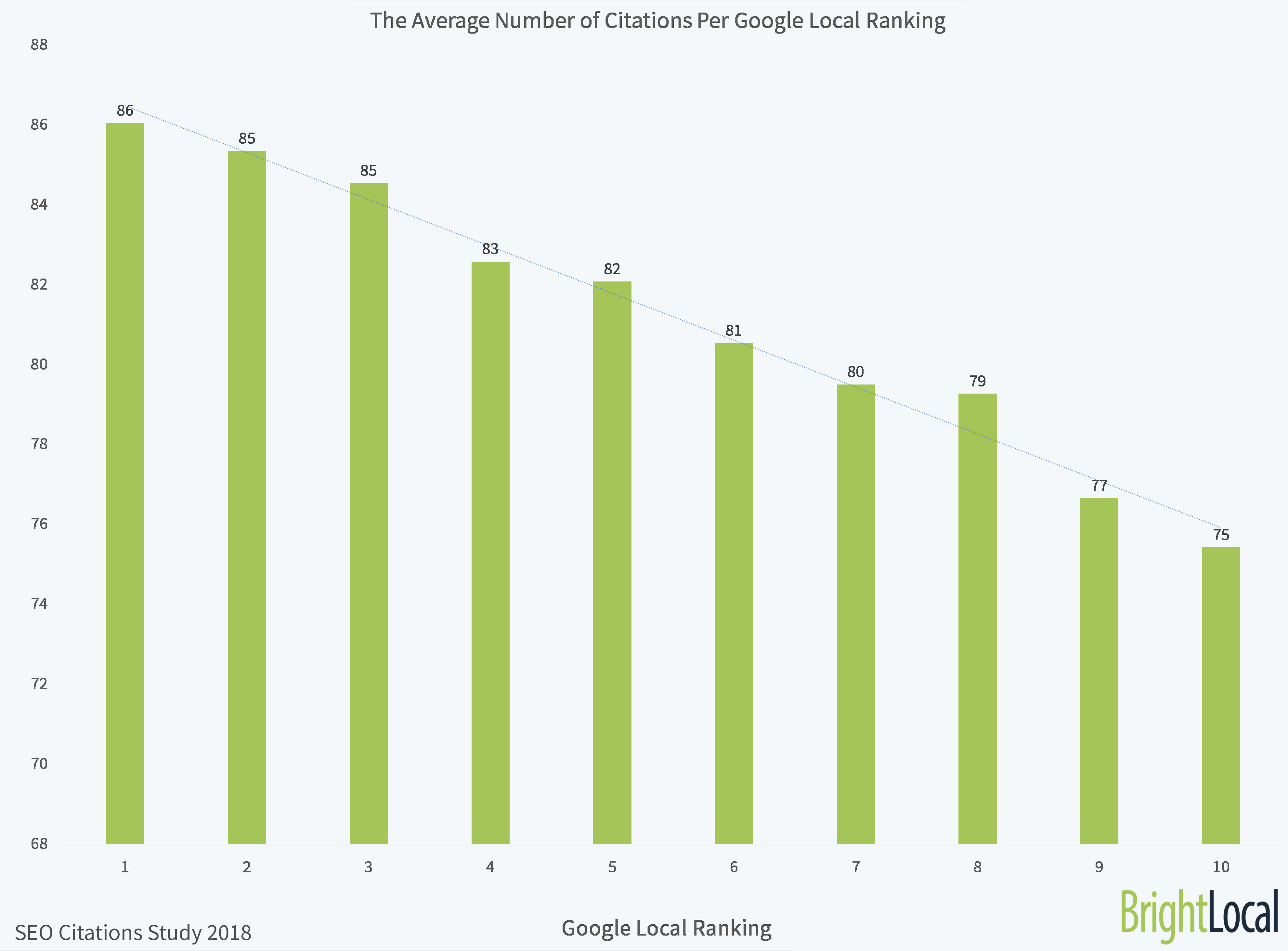
Traditional ranking still counts citations too. BrightLocal’s citations study, which analyzed 122,125 local businesses across 26 industries, found that businesses ranked #1 in Google Local have an average of 86 citations, versus 75 for position #10. Businesses in the top 3 for a given search consistently had more citations than everyone else in the top 10.
The Only Three Ranking Factors That Matter for Citations
Whitespark’s 2026 data is worth understanding because it tells you exactly where to focus. Here are the citation-specific factors that scored highest across local pack, local organic, and AI search visibility:
| Ranking area | Highest-impact citation factor | Score |
| AI search visibility | Quality/Authority of Unstructured Citations (news, blogs, gov, industry associations) | 160 |
| AI search visibility | Quantity of Unstructured Citations | 147 |
| AI search visibility | Quantity of Citations from Industry-Relevant Domains | 133 |
| Local organic | Quality/Authority of Unstructured Citations | 125 |
| Local organic | Quantity of Citations from Industry-Relevant Domains | 121 |
| Local pack / Maps | Consistency on Primary Search Engines (Google, Bing, Apple Maps) | 124 |
| Local pack / Maps | Quality/Authority of Structured Citations | 105 |
Source: Whitespark 2026 Local Search Ranking Factors.
Boiled down, that gives you three priorities:
- Consistency across the primary search engines — Google, Bing, and Apple Maps. Non-negotiable.
- A small set of high-authority structured citations — the ones your customers actually use and the ones the AI systems actually cite.
- Unstructured mentions in industry-relevant and locally-relevant places — press coverage, “best of” lists, association sites, community publications, and industry blogs.
Notice what isn’t on that list: raw quantity. Submitting to 200 directory farms scored dead last in every category.
The Top General Citation Sites in 2026
Start here — these are the sites every local business should be on, regardless of industry. Domain Authority scores are from BrightLocal’s Top 50 General Citation Sites list.
| Citation site | Domain Authority | Free / Paid | Why it matters |
| Google Business Profile | 100 | Free | The single most important local citation — everything else supports this |
| Apple Business Connect | 99 | Free | Feeds Apple Maps and Siri; the “second search engine” |
| LinkedIn Company Page | 99 | Free | Trust + B2B discovery + AI grounding source |
| Facebook Business Page | 96 | Free | Cross-checked by Google; heavy customer usage |
| Instagram Business | 94 | Free | Discovery + visual proof + linked from GBP |
| Yelp | 93 | Free | Trust source AI systems reference; review authority |
| Trustpilot | 93 | Free / Paid | Review authority + strong SERP presence |
| Bing Places | 51 | Free | Feeds Bing search + Copilot answers |
| Foursquare | 92 | Free / Paid | Data aggregator — feeds downstream apps |
| Better Business Bureau | High | Paid | Trust signal; increasingly cited in AI results |
| Yellow Pages (YP.com) | High | Free / Paid | Traditional authority + local pack citations |
| Nextdoor Business | 83 | Free | Neighborhood recommendations; strong for service businesses |
| MapQuest | High | Free | Still surfaces in local queries |
| Chamber of Commerce | Varies | Paid | Locally-relevant authority signal |
Get these ten to fifteen correct before you touch anything else. If your NAP is inconsistent across even a few of these, no amount of Tier 3 submissions will help you.
Best Citation Sites by Industry
This is where competitors’ “top 100 citations” lists fall apart — the citations that actually move rankings depend on your industry, because that’s what search engines and AI systems weight most heavily as “industry-relevant.” A dentist doesn’t need to be on Angi. A plumber doesn’t need to be on Healthgrades. The Whitespark 2026 report named industry-specific directories and “top 10” lists as major grounding sources for AI-generated local recommendations.
The table below lists the citations that carry the most weight in each industry, based on BrightLocal’s industry data, Whitespark’s ranking-factor survey, and Client Studio’s industry citation breakdown.
| Industry | Priority industry citations | Avg. citations for top-ranked businesses |
| Restaurants & Cafés | Yelp, TripAdvisor, OpenTable, Zomato, Eater, HappyCow, local food blogs | High (~top of all industries) |
| Hotels & B&Bs | TripAdvisor, Booking.com, Expedia, Google Travel, Trivago | Highest across all industries |
| Bars & Pubs | Yelp, TripAdvisor, Untappd, Google Business Profile, local event sites | High |
| Healthcare (Doctors/Clinics) | Healthgrades, WebMD, Zocdoc, Vitals, CareDash, U.S. News Best Physicians | ~101 |
| Dentists | Healthgrades, Zocdoc, 1-800-Dentist, ADA Find-a-Dentist | ~107 |
| Senior Living | A Place for Mom, Caring.com, SeniorAdvisor, U.S. News Best Senior Living | ~94 |
| Legal Services | Avvo, Justia, FindLaw, Martindale-Hubbell, Lawyers.com | High |
| Home Services (HVAC, plumbing, electrical) | Angi, HomeAdvisor, Thumbtack, Porch, BBB, Houzz | Moderate |
| Contractors & Remodeling | Houzz, Angi, BuildZoom, HomeAdvisor, Porch, Better Business Bureau | Moderate |
| Real Estate | Zillow, Realtor.com, Redfin, Trulia, Homes.com | Moderate |
| Automotive Services | Cars.com, RepairPal, Edmunds, AutoMD, Kelley Blue Book | Moderate |
| Fitness & Gyms | ClassPass, Mindbody, YogaTrail, Fitness.com | Moderate |
| Finance & Accounting | BBB, CPA Directory, SmartAsset Advisor Directory, Chamber of Commerce | ~Low (34–40) |
| Photography | The Knot, WeddingWire, Zola, ShootProof, local wedding blogs | Lowest (~34) |
| Tradesmen (roofing, painting, landscaping) | Angi, HomeAdvisor, Thumbtack, Google Business Profile, industry-association directories | Low (~lowest three) |
Average citation counts by industry: BrightLocal SEO Citations Study.
A quick note for tradesmen and photographers: your industries are consistently the worst for citation coverage, which means it’s also the easiest place to leapfrog competitors. BrightLocal’s data found 18% of tradesmen aren’t even on the top 10 citation sites. Fix that and you’re already ahead of nearly one in five direct competitors.
The Data Aggregators That Feed Everything Else
Here’s a shortcut most guides skip: instead of manually submitting to 50 directories, submit to the four sources that quietly feed most of them.
In the U.S., the main data aggregators are:
| Aggregator | Feeds (partial list) |
| Data Axle (formerly Infogroup) | Superpages, DexKnows, Manta, Citysearch, Whitepages, Yellowbook, MapQuest, Bing, and others (BrightLocal) |
| Neustar Localeze | YP.com, Apple Maps, Bing, EZLocal, Hotfrog, Yahoo! Local, TripAdvisor, and others (BrightLocal) |
| Foursquare / Factual | Apple Maps, Bing, Yelp, TripAdvisor, Citysearch, and others (BrightLocal) |
| Apple Business Connect | Apple Maps, Siri, Spotlight, and third-party apps that use Apple’s map data |
If your NAP is correct at these four sources, a huge chunk of downstream directories will inherit correct data over the following weeks and months. If your NAP is wrong at an aggregator, that error will spread out to dozens of sites and be much harder to clean up.
NAP Consistency: The Rule That Beats All the Others
Every citation you build has to include your business name, address, and phone number in exactly the same format as every other citation. Not close. Not similar. Exactly the same.
Google, Bing, and AI systems cross-reference NAP across the web to verify you’re real. Inconsistency dilutes that signal. Consistent NAP is what lets your business get pulled into Google’s local 3-pack (aka the Map Pack), keeps duplicate profiles from splitting your reviews, and — critically in 2026 — makes you a “safe” source for AI systems to cite.
The most common places consistency breaks:
- Business name: “LLC,” “Inc.,” “Co.,” or DBA differences (“Dallas Plumbing” vs. “Dallas Plumbing LLC”)
- Address: “St.” vs. “Street,” “Ste. 200” vs. “Suite 200” vs. “#200,” abbreviated cities
- Phone number: dashes vs. no dashes, tracking numbers on one directory and a real number on another, mobile vs. main line
- Website URL: with or without www, http vs. https, trailing slash vs. none

Build a “Single Source of Truth” File
Before you audit or submit anywhere, decide exactly how your NAP will appear everywhere. Write it in a plain-text file or a spreadsheet cell. Then copy-paste that exact text into every listing.
Sample source-of-truth block:
- Business Name: Major Fluke
- Address: 1234 Main St, Suite 200
- City / State / ZIP: Grants Pass, OR 97526
- Phone: (541) 224-8169
- Website: https://majorfluke.com
- Primary Category: Search Engine Optimization
This one file becomes the reference for everything — new submissions, audit corrections, and even your website’s footer and schema markup.
The Citation Audit and Cleanup Workflow
For most local businesses, cleanup beats new submissions on ROI every time. If you already have listings out there, they’re almost certainly inconsistent — and fixing what’s broken will move rankings faster than adding new profiles.
Here’s the workflow we use:
Step 1: Pull Your Existing Citation Footprint
Use one of these tools to see what already exists:
- Whitespark Local Citation Finder — the industry standard for surfacing existing citations
- BrightLocal Citation Tracker — good for audit + ongoing monitoring
- Semrush Listing Management — includes an aggregator-based cleanup and works if you already use Semrush
- Moz Local — solid for U.S. businesses, integrates with data aggregators
You can also do extensive manual searches and Google your business name and phone number in quotes (“(541) 224-8169”) to surface listings a tool might miss.
Step 2: Score Each Listing
For every citation the tool surfaces, note:
- Does the business name match your source of truth exactly?
- Does the address match, including suite and abbreviation format?
- Is the phone number correct and identical?
- Is the website URL correct (protocol, www, trailing slash)?
- Is the primary category correct?
- Is there a duplicate listing for the same business?
Anything with a mismatch goes on your fix list. Duplicates get merged or claimed and closed.
Step 3: Fix Existing Errors Before Adding Anything New
Correct or delete listings in this order:
- Google Business Profile — you should own and control this directly.
- Apple Business Connect, Bing Places, Facebook Business — the other primary signals Google cross-checks.
- Yelp, BBB, Yellow Pages — high-authority structured citations Google (and AI systems) reference heavily.
- The industry-specific citations from the table above — Healthgrades, Avvo, Angi, TripAdvisor, or whichever match your category.
- The data aggregators — Data Axle, Neustar Localeze, Foursquare. Fix the source and downstream sites inherit the correction.
Step 4: Fill the Gaps With New Submissions
Only after existing listings are clean should you submit to new sites. Prioritize:
- Any general citations from the top 15 list above you’re missing
- Your industry-specific priorities
- Your local Chamber of Commerce and any city/regional business directories
- Any relevant industry associations you’re a member of (association member directories are among the most trusted unstructured citations for AI search)
Step 5: Layer in Unstructured Citations
This is where most local businesses stop, and it’s exactly where the biggest AI-search gains live. Look for opportunities to get mentioned in real content:
- Sponsor a local event and get listed on the event page
- Pitch a “best of” list author for your industry (roundups get referenced constantly by AI)
- Publish a guest post on a local news site or industry blog
- Get quoted in a local newspaper (HARO, Qwoted, or Connectively pitches work here)
- Join and get profiled by an industry association
- Get on a local podcast — show notes are indexed and cited
Each of these creates the kind of high-authority, industry-relevant unstructured citation that scored highest in Whitespark’s AI search visibility ranking factors.

Step 6: Quarterly Maintenance
Citations drift. Phone numbers change, hours update, staff changes cause profile edits, and duplicates appear over time. Audit your top 20 citations every 90 days and fix anything that’s drifted.
The Five Most Common Citation Mistakes
After years of doing this for clients, the same mistakes come up over and over:
- Building citations before fixing existing ones. Adding 30 new listings won’t overcome 20 old ones with the wrong phone number. Audit first.
- Using a call-tracking number on citations. Different phone numbers on different sites is the fastest way to destroy NAP consistency. Use call tracking that forwards to your main line, and always publish the main line on citations.
- Chasing quantity over relevance. One Whitespark contributor said they now build only 10 to 20 citations per client. Ten good citations beat 100 directory-farm submissions.
- Ignoring service-area business setup. If you travel to customers (plumbers, HVAC, mobile services), configure service areas properly on GBP and any directory that supports it — not a fake storefront.
- Skipping unstructured citations entirely. Every business over-invests in directory listings and under-invests in press mentions, association profiles, and “best of” roundups — which is exactly where AI-search visibility now lives.
How Many Citations Do You Actually Need?
The honest answer: fewer than you think, done right.
BrightLocal’s data puts the average for #1-ranked businesses at 86 citations, but that number is inflated by industries with heavy legacy directory footprints (dentists average 107, hotels top the list, photography averages only 34). Whitespark practitioners are now recommending 10–20 quality citations for many businesses.
A realistic target:
- Every business: the top 10–15 general citations, all consistent
- Plus 5–10 industry-specific citations from the table above
- Plus 5–10 locally-relevant citations (Chamber, local news mentions, community directories)
- Plus ongoing unstructured citations — this is where you keep growing over time
That’s a working footprint of 25–40 high-quality citations, plus a growing base of press mentions and “best of” list appearances. That will beat 200 directory-farm submissions every time.
Make Sure Your Business Is Listed Where It Matters
Building more citations isn’t the goal. Building the right citations, keeping your business information consistent, and earning mentions from sources Google and AI search engines trust is what matters. If you want help cleaning up your listings and strengthening your local visibility, Major Fluke can help. As a Medford SEO company serving businesses throughout Southern Oregon, we build local SEO strategies around the places your customers — and search engines — actually look. Use the form below to contact us, and let’s find out where your local presence has room to grow.