

You did everything right. Claimed the profile, gathered reviews, maybe paid someone to “do your SEO.” So why are the calls drying up?
The honest answer is rarely bad luck. It usually comes down to a handful of local SEO mistakes, and the cost of making them has climbed sharply in the past year. The map pack you fought to crack is seen by far fewer people than it used to be, because AI Overviews now sit above it on most local searches and answer the question before anyone scrolls.
Some businesses have lost half their visibility without touching a thing.
The fixable part is the good news.
Below are fifteen of the costliest local SEO mistakes, what each one quietly takes from your bottom line, and exactly how to undo it.
The short version: 15 local SEO mistakes costing you customers
- Setting up your Google Business Profile and walking away
- Stuffing keywords into your business name
- Choosing the wrong primary category
- Letting your name, address, and phone number drift out of sync
- Editing your profile carelessly and triggering re-verification
- Misconfiguring your service-area settings
- Optimizing for the map pack and ignoring AI Overviews
- Staying invisible to ChatGPT, Perplexity, and Gemini
- Running a website too thin for AI to cite
- Skipping structured data
- Counting reviews instead of earning recent ones and replying
- Posting stale or stock photos
- Ignoring Q&A, messaging, and booking
- Tracking rankings instead of revenue
- Not knowing which mistake is hurting you most
Find the ones that sound like you, then read the fix.
The Basics You Only Think You’ve Handled
1. You Set Up Your Google Business Profile And Walked Away
A complete Google Business Profile feels like a finish line. It isn’t – there is so much more to Local SEO.
Google has changed how it ranks local results. The weight has moved toward popularity signals like clicks, calls, review activity, and post engagement, and away from how long you’ve been in business. A profile that sits untouched reads as inactive, and an inactive profile slides while a newer, busier competitor climbs past it. The customers who would have called you are calling them instead.
The fix is to treat the profile as a channel, not a listing. Post through Google Posts weekly, add fresh photos monthly or quarterly, reply to Google reviews within a day (turn on email notifications!), and update your details as they change.
A profile that always looks alive is exactly what Google rewards now. This is the core of what real local SEO strategy involves.
2. You Stuffed Keywords Into Your Business Name
“Joe’s Plumbing” became “Joe’s Plumbing | Emergency Drain Repair Grants Pass” at some point, and for a while, it probably nudged you up the map.
That move has aged badly. Google’s March 2026 update set off a wave of suspensions aimed squarely at keyword-stuffed names, and trades like plumbing, moving, and contracting took the hardest hits. A suspension isn’t a ranking dip. Your listing vanishes, sometimes for weeks, while you fight to get it back.
So the rule now is boring on purpose. Use the name on your truck and your invoices, nothing more.
3. You Picked The Wrong Primary Category
Your primary category might be the most powerful setting in your whole profile, and you probably chose it in about four seconds.
This is critical because a general contractor filed under “Construction company” instead of “General contractor” can disappear for the exact phrase customers type, because Google reads that category as a direct statement of what you do. Too broad, or slightly off, and you go invisible for the searches that actually convert.
Get specific. Choose the category that describes your core service most precisely, then add every relevant secondary one Google offers. Look at what your top-ranked competitors use and follow the logic behind it, not just the label, and revisit the list every few months, since Google quietly adds and renames categories.
4. Why Is Your Name, Address, And Phone Number Different Around The Web?
A moved office, a new area code, and an old listing nobody updated. Small changes like these pull your business details out of sync across the web, and no alarm goes off when they do.
Google reads that inconsistency as doubt. Mismatched name, address, or phone entries chip away at the confidence it has in your business, and softer confidence means softer rankings. The same messiness follows you into AI results, where conflicting data makes you a shakier source to cite. Two live phone numbers is the costliest version, quietly sending paying customers to a line you stopped answering months ago.
Lock in one exact version of your details and make every listing match it character for character, then hunt down the old and duplicate entries hiding on directories and data aggregators. A free local SEO scan shows you where they conflict before they cost you the next call.
5. You Edit Your Profile Without Thinking Twice
Most advice tells you to keep your profile fresh. True enough, but how you edit matters as much as whether you edit.
Change your name, address, category, or phone number carelessly, and you can trip Google’s verification system, which pulls your profile into review for days or even weeks while it confirms you’re legitimate. During that window, your visibility can crater. The freshness that helps you comes from posts, photos, and replies, not from poking at the core fields Google treats as your identity.
Edit the sensitive stuff deliberately and rarely, and only when something is genuinely wrong. Save the constant activity for the parts of the profile built to be updated.
6. Your Service-Area Settings Are Working Against You
Service-area businesses get a setting that storefronts don’t, and plenty of them set it wrong.
If customers come to you, show your address. If you go to them, hide the street address and define your service areas instead. Get this backwards, and you either confuse Google about where you operate or broadcast an address that hurts you. A house-call business listing a private home address, or a real shop hiding the one customers need, both leak visibility and trust in opposite directions.
Match the setting to how your business actually works, then list the towns and regions you truly serve rather than padding the list with places you’ll never drive to. Google notices the padding, and it doesn’t help.
The 2026 Shifts Most Businesses Haven’t Caught
7. You Optimized For The Map Pack And Ignored the AI Overview
For years, the whole game was cracking the top three in the map pack. That game is shifting under your feet.
On a growing share of local searches, Google now drops an AI Overview above everything else, answers the question in a sentence or two, and names only one or two businesses. The map pack still appears, especially for simple “near me” lookups, but fewer people scroll far enough to reach it. If your business isn’t the one the AI names, you’re not in second place. You’re off the part of the page that the customer actually reads.
The work now is to become the answer, not just a result. Publish clear, direct pages that state what you do, where, and for whom in language a machine can lift cleanly. Keep your profile and reviews consistent with that, because the AI pulls from both. The businesses earning citations are the ones whose information is specific, accurate, and easy to quote.

8. You’re Invisible To ChatGPT, Perplexity, And Gemini
A customer used to ask Google for the best roofer in town. Now plenty of them ask ChatGPT, Perplexity, or Gemini instead, and those tools hand back a short list with no map in sight.
If your business never surfaces in those answers, you don’t exist for that customer, and you’ll never even see them slip away, because there’s no click to track. These assistants build their recommendations from your website, your reviews, and the structured data behind your pages, the same signals that feed Google’s AI. Clean those up, and you start appearing in places your competitors don’t yet know to look.
9. Your Website Is Too Thin To Cite
A one-page site with a phone number and a logo was fine when humans did all the searching. It falls apart now.
AI answers and the local pack both pull from real content, and a thin site gives them almost nothing to work with. No service pages, no location pages, no plain explanation of what you fix and who you help, and there’s simply nothing for Google or an AI to quote you on. Your competitor with ten solid pages becomes the easy source, every single time.
Give each core service its own page and each area you serve its own as well, written for a person but structured so a machine can follow it. This is where content and web development stop being nice-to-haves and start being the reason you do or don’t get found.
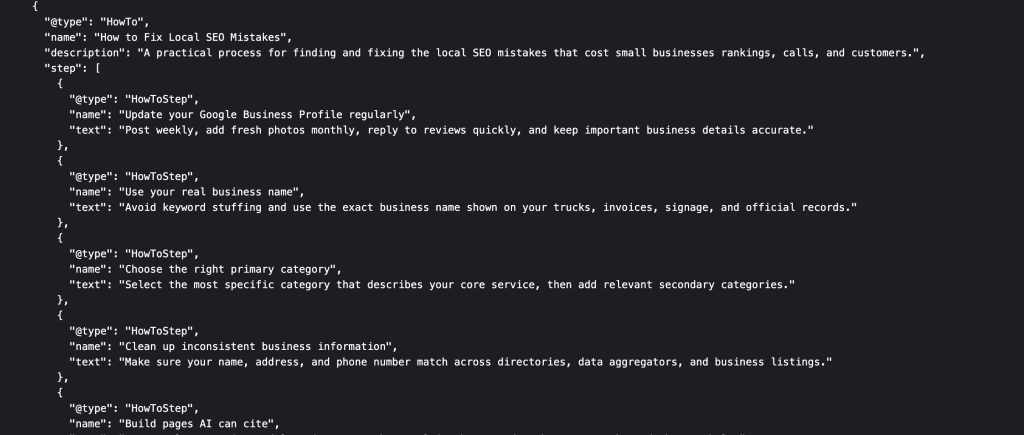
10. You Skipped Structured Data
Structured data sounds like something only a developer should care about. The idea is simpler than the name.
It’s a bit of code that labels your information for search engines and AI, telling them which part is your address, which is your hours, which is a review, and which is a service.
You don’t need to hand-code anything. Most platforms have a plugin or built-in setting for local business schema, and getting it right is squarely a technical SEO job worth handing to someone who does it daily.
Where You Lose Customers After They Find You
11. You Count Reviews Instead Of Earning Recent Ones
A pile of five-star reviews from three years ago feels like an asset. To a customer reading today, it looks like a business that peaked a while back.
Recency and rhythm now matter as much as the total. A steady trickle of fresh reviews tells both Google and a wary customer that you’re active and still good, while a dead review feed quietly raises doubt. Silent owners make it worse. A profile where nobody ever replies looks unattended, and an unanswered complaint sits there working against you in public.
Ask for reviews on a regular cadence rather than one big push, and reply to every one, the glowing and the bruising alike. A calm, useful response to a hard review often sells better than the praise above it.
12. Your Photos Are Stale Or Stock
The stock photo of a smiling model in a clean hard hat fools no one, and the last real picture you uploaded was two winters ago.
Photos pull more weight than most owners expect. People decide in seconds whether you look real and competent, and Google now counts photo engagement among the signals that nudge rankings. Stale or fake images cost you on both fronts at once.
Shoot real ones on your phone: your team, your trucks, finished jobs, the actual storefront. Add a few every month. Honest and current beats polished and generic every time.
13. You Treat The Profile As A Billboard, Not A Storefront
You check your profile for new reviews and call it done. Meanwhile, three people asked a question in the Q&A last month and got no response.
Your profile is a place customers try to interact, not a poster they read. Unanswered questions, ignored messages, and a booking option you never switched on are all small doors you’ve left locked. Each one is a ready-to-buy customer who took a step toward you and hit a wall.
Turn on messaging and actually watch it. Answer questions in the Q&A, and seed the obvious ones yourself. Add a booking or a clear next step if your business allows it. The customer who reaches out is the closest one to paying you, so make that the easiest thing they do all day.
The Blind Spots in How You Measure
14. You Track Rankings Instead Of Revenue
A screenshot of a number-one ranking feels like a win. It doesn’t deposit anything in your account.
Rankings are a means, not the point. What pays you is calls, direction requests, form fills, and booked jobs, and a business can rank well while quietly converting almost no one. If you can’t see which keywords and pages actually drive customers, you’re steering by vanity numbers and guessing at the next move.
Track the outcomes that map to money, and keep them somewhere you can check anytime instead of buried in a once-a-quarter report. Live dashboards that tie your SEO to real leads turn “we think it’s working” into “here’s exactly what’s working and what to do next.” That visibility is the whole point of doing this well.

15. You Don’t Know Which Mistake Is Hurting You Most
You just read fourteen ways local businesses lose customers, and a few of them probably landed close to home. The trap now is trying to fix everything at once, or freezing because you can’t tell which one is doing the most damage.
The fastest path is a clear look at where you actually stand. Find out which listings conflict, which signals are weak, and where you’ve gone missing from the answers customers see.
16. Your Industry and Niche Are Inundated with Local Service Ads
In competitive industries and densely populated metro areas, organic Local SEO may not be enough to get noticed. Google often displays Local Services Ads (LSAs) prominently for high-demand searches like plumbers, dentists, lawyers, electricians, and other local service providers. These pay-per-lead ads can appear before traditional Google Business Profile and organic results, giving participating competitors an additional opportunity to capture high-intent customers.
Check whether your business and service area qualify for Local Services Ads. If they do, consider running LSAs alongside your Local SEO strategy to increase your overall visibility on Google.
See more at business.google.com/us/ad-solutions/local-service-ads/
Stop Losing Customers To Fixable Mistakes
None of this comes down to luck. It comes down to work, and most of these fixes you can start this week. Pick the two or three that hit closest to home and handle those first. If you want the full picture before you dig in, a free local SEO scan shows you exactly where you stand across the listings and signals that decide whether customers find you or the shop down the road.
Rather hand the whole thing off? That’s what we do as a Medford SEO company. We build the right mix of local SEO, content, and technical fixes for small businesses that put in the work, and we make the results easy to see. Work hard. Let luck follow. Fill out the form below and find out what’s costing you the most.
Read More: