
Your contractor website is either working to bring in local jobs or quietly costing you them, and the difference usually comes down to a handful of specifics. A site that ranks locally shows up when someone nearby searches for your trade, earns their trust in a glance, and makes calling you the easy next step. Here are ten things every contractor website needs to do exactly that.
1. A Dedicated Page For Every Service
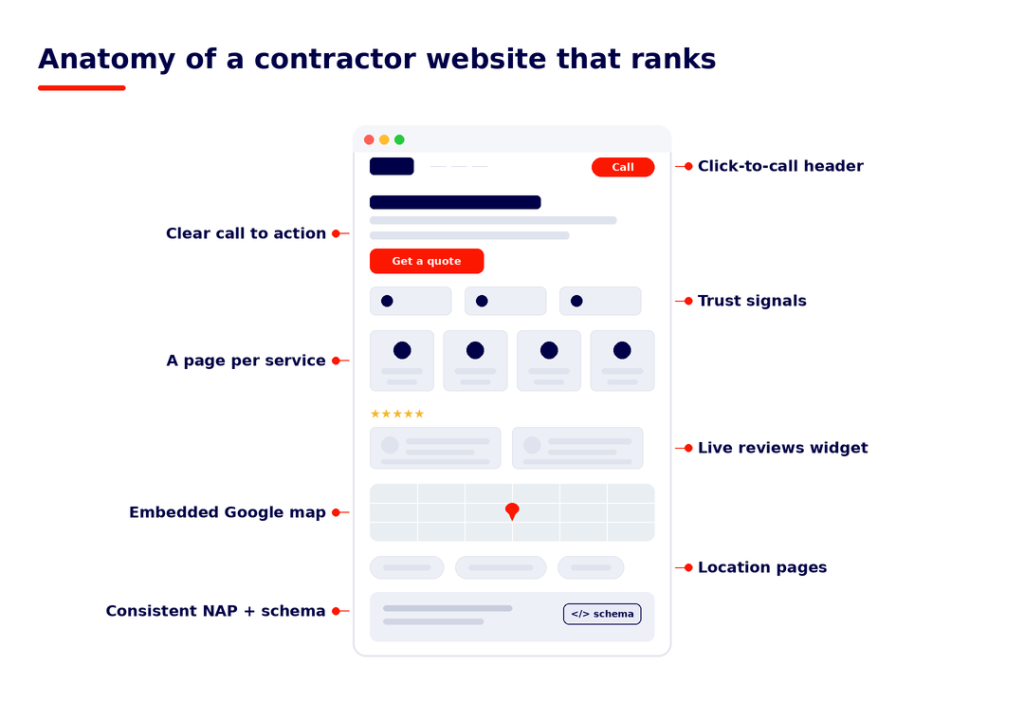
One “Services” page listing everything you do gives Google nothing specific to rank. Split it. Build a separate page for each core service, each one focused on a single job and written around the words customers actually search. A roofer needs a roof repair page, a roof replacement page, and a storm damage page, not one page that mentions all three in passing.
2. Location Pages For Every Area You Serve
If you work across several towns, a single homepage won’t rank you in all of them. Give each real service area its own page with genuinely local content, the neighborhoods you cover, jobs you’ve done there, and details only a local would know.
Warning: Avoid copying one location page and swapping the city name across a dozen versions. Google treats near-identical pages as doorway spam. This can harm your entire website. Each page needs real, different content or it does more harm than good.
3. Fast Performance On A Phone
Most people search for a contractor on their phone, often in a hurry, sometimes in an emergency. A site that loads slowly or feels clumsy on mobile loses them before they read a word, and Google factors that speed and mobile experience into rankings. Compress your images, cut anything bloated, and test your site on an actual phone, not just your desktop.
4. Click-To-Call And Consistent Contact Info
A contractor site lives and dies by the phone call. Put a tappable phone number in the header on every page so someone can call in one tap, and make sure your name, address, and phone number match exactly everywhere they appear online.
Google leans on that consistency to trust your business, and mismatched numbers quietly send customers to a line you no longer answer.
5. Your Google Business Profile Embedded On The Page
Embedding your Google map and business profile on your contact page does two useful things at once. It shows visitors you’re a real, established local business, and it reinforces to Google the connection between your website and your profile, the same profile that powers your map pack ranking.
6. A Live Reviews Widget
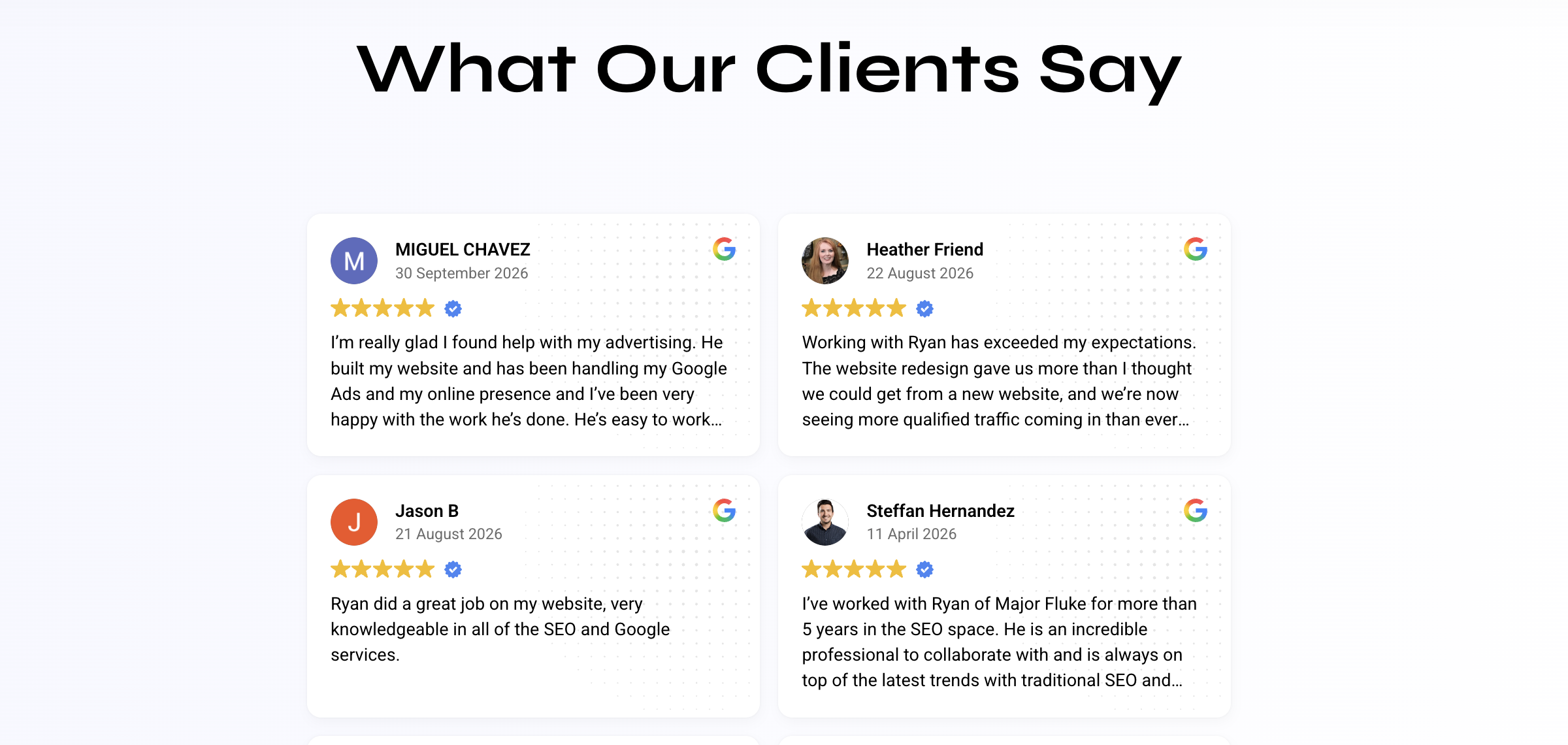
Reviews are one of the strongest trust signals a contractor has, so don’t bury them on a third-party site. Pull your real Google reviews onto your homepage and service pages with a widget that updates automatically. Fresh, visible reviews reassure the nervous first-time customer and reinforce the reputation that helps you rank.
7. A Clear Call To Action On Every Page
A visitor should never have to hunt for the next step. Every page needs an obvious call to action, a “Get a free quote” button, a “Call now” line, a short contact form, matched to where the reader is. Use action words that fit the job rather than a limp “Submit,” and repeat the ask near the top and the bottom of longer pages.
8. Schema Markup
Schema is code that labels your site for search engines, telling them this is a local business, here’s the service, here’s the area, here’s a review. It doesn’t change what visitors see, but it helps you qualify for rich results and makes your pages easier for AI to read and quote.
Pro Tip: You don’t need a developer for this. A plugin like Rank Math or Yoast adds local business, service, and FAQ schema in a few clicks.
9. Internal Links That Tie The Site Together
Your pages shouldn’t sit on islands. Link your homepage to your service pages, your service pages to related services and location pages, and everything to your contact page.
Those links help Google understand your site and pass ranking strength to the pages that need it. For a deeper walkthrough, this local SEO guide for service pages covers how the pieces fit together.
10. A Secure, Trustworthy Foundation
The basics still matter. Your site needs HTTPS, so browsers don’t flag it as “not secure,” a clear layout that works on any screen, real photos of your team and finished work, and visible trust signals like licenses, insurance, and guarantees. None of it is flashy, but together it tells both Google and a wary homeowner that you’re the real thing.
Where Most Contractor Sites Fall Short
Few contractor websites are missing everything on this list. Most are missing three or four, and those gaps are exactly where the calls leak out. Pick the ones your site is weakest on and fix those first, starting with service pages, mobile speed, and reviews, since those move the needle fastest.
You Build The Homes. We’ll Build The Site That Fills The Calendar.
A contractor website that ranks takes the right structure, the technical details, and content built to convert, and that’s the whole job on our end. We’ll build the pages, tune the speed, wire up the profile and reviews, and get you showing up where your customers are already searching. SEO, content, and the technical side, the whole mix, handled. Talk to the team and let’s get your site working as hard as you do.
Frequently Asked Questions About Contractor Websites
How much does a contractor website cost?
It ranges widely, from a few hundred dollars for a basic template site to several thousand for a custom, SEO-built one. The better question is what it returns. A site that consistently brings in local jobs pays for itself fast, while a cheap one that never ranks costs you every lead it fails to catch.
Do I really need a website if I have a Google Business Profile?
Yes. A Google Business Profile gets you into the map pack, but a website is where you rank in regular search, show your work in depth, and give both customers and Google more reasons to trust you. The two work together, and the profile performs better when a strong site backs it up.
How many pages should a contractor website have?
Enough to cover each service and each area you serve, often somewhere from eight to twenty. Build a real page for every core service and location worth ranking for, plus the essentials like an about page, a contact page, and a reviews or gallery page.
How long does it take for a contractor website to rank?
Usually a few months for local terms, longer in competitive markets. New sites take time to earn trust, and rankings build as you add content, gather reviews, and stay consistent. The sites that win are the ones kept active, not launched and left alone.