
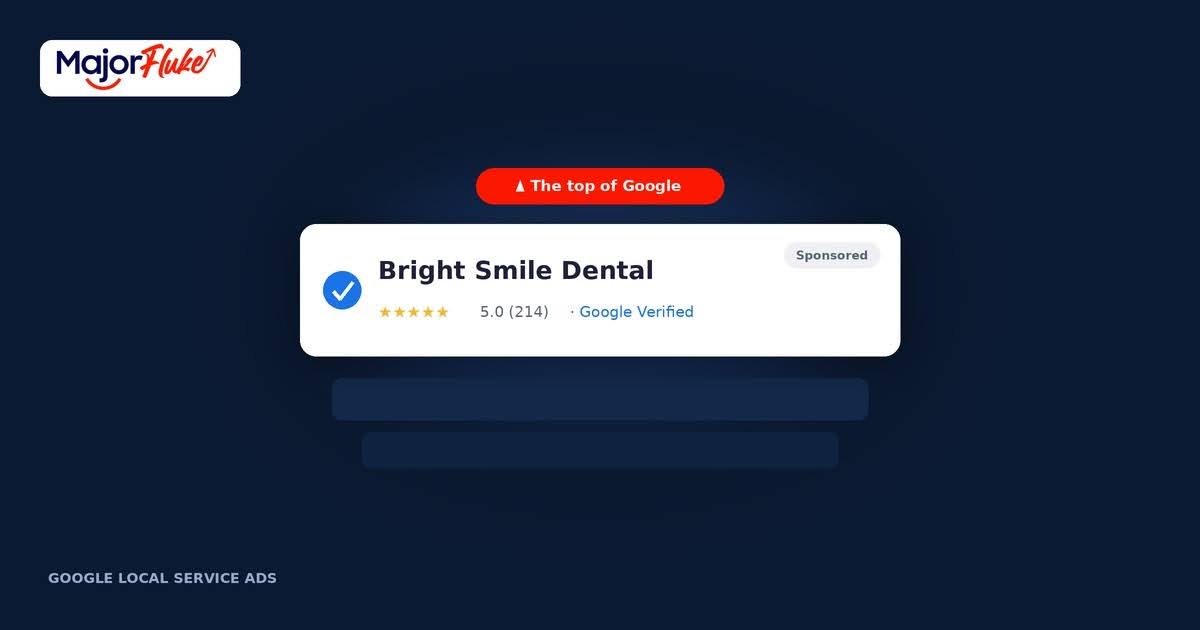
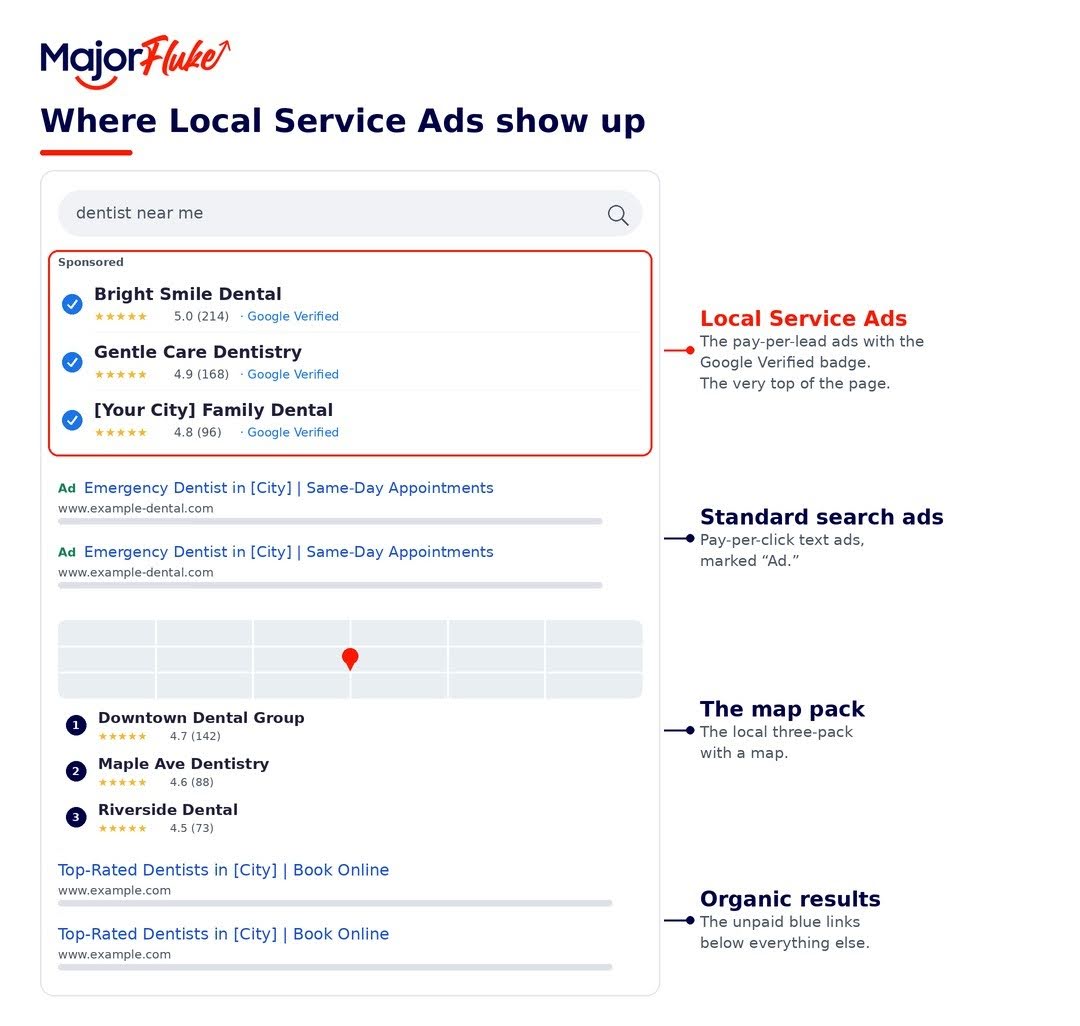
Google Local Service Ads are the pay-per-lead ads that sit all the way at the top of Google when someone searches for a local service, above the regular ads, the map pack, and every organic result. Instead of paying for clicks, you pay only when a real customer calls or messages you. For home and health service businesses alike, they can be the most visible spot on the page, though they aren’t the right fit for everyone. Here’s how they work, which businesses qualify, and how to tell whether they belong in your marketing.
What are Google Local Service Ads?
Google Local Service Ads are pay-per-lead ads that place your business at the very top of local search results, marked with a Google Verified badge. When someone searches for a plumber, a dentist, or a lawyer nearby, these ads show first, displaying your name, your rating, and a badge that tells searchers Google has checked you out.
That badge used to be called Google Guaranteed or Google Screened. In late 2025, Google folded them into a single blue Google Verified checkmark, earned by passing license, insurance, and background checks. It’s the trust signal that makes these ads work, since people are far more likely to call a business Google has vouched for.
Which Businesses Qualify For Local Service Ads?
Local Service Ads aren’t open to everyone, but the list of eligible categories has grown well past the home trades. Google now runs them across several groups.
Home services, like plumbing, HVAC, roofing, electrical, and cleaning.
Health, like dentists, optometrists, and primary care.
Business and legal, like lawyers, accountants, and real estate agents.
Wellness, beauty, care, and learning, like massage, salons, child care, and tutoring.
Availability shifts by category and location, so the safest move is to check Google’s eligibility tool before you plan around it. One caveat worth knowing if you’re in health or wellness. Because of medical privacy rules, healthcare practices generally can’t dispute leads or pull call recordings the way a home-service business can, which makes fast, clean lead handling matter even more.
How Local Service Ads Work
The model is refreshingly simple. You set an average weekly budget, and Google shows your ad to nearby people searching for what you offer. You pay only when someone contacts you through the ad, a call, a message, or a booking, not when they see it or click it. If a lead turns out to be spam or clearly outside your area, most businesses can dispute it, and Google credits them back.
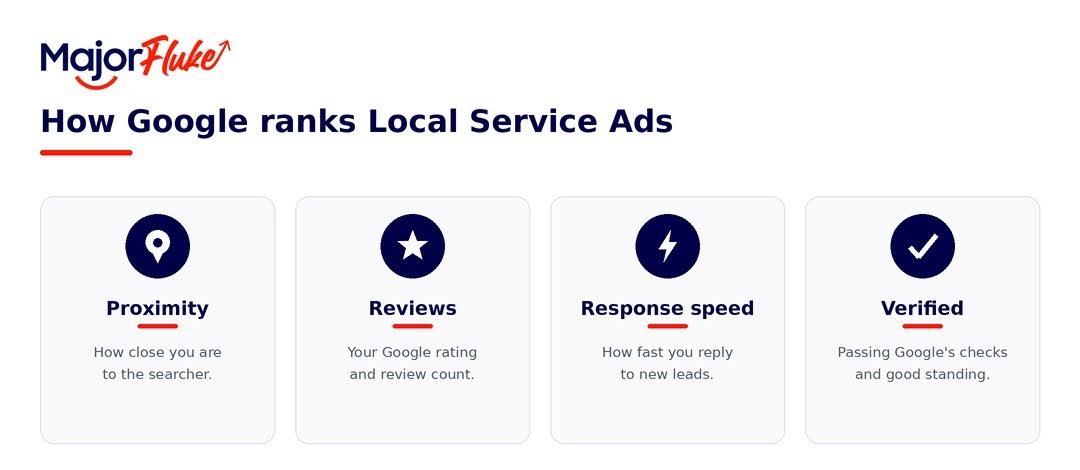
Where you land among the ads comes down to a handful of factors, not just how much you spend.
- Your proximity to the searcher.
- Your review score and how many reviews you have, now pulled straight from your Google Business Profile.
- How fast you respond to leads.
- Your hours, and whether you’re currently verified and in good standing.
Responsiveness and reputation matter as much as budget. A business that answers fast and keeps strong reviews can outrank one that’s simply throwing money at the problem.
How They Differ From Standard Search Ads
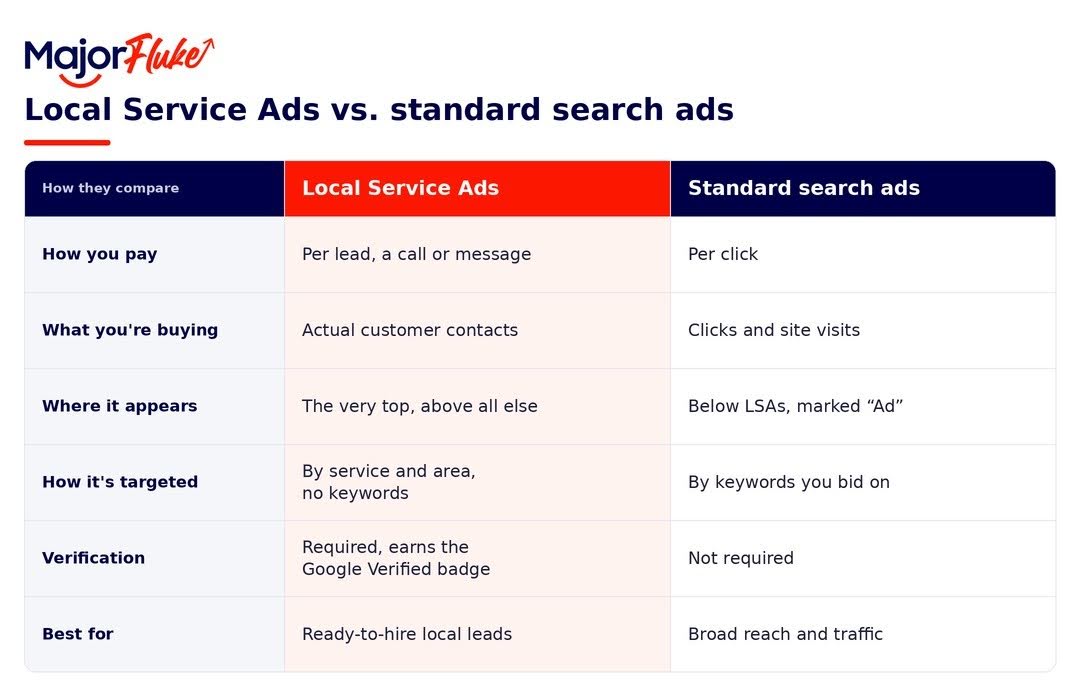
It’s easy to lump Local Service Ads in with standard Google search ads, but they solve different problems. Standard search ads charge you per click, which means you can pay for curiosity, comparison shoppers, and people who never intended to hire. Local Service Ads charge per lead, so your money goes toward actual contacts instead of clicks that go nowhere. They also sit higher on the page and require verification, which standard ads don’t. For most local businesses, the pay-per-lead model is more predictable, though the two can absolutely work together.
The Upsides
For the right business, the appeal is hard to argue with.
- You only pay for real leads, which makes spending predictable.
- The Google Verified badge builds instant trust.
- You get the most visible spot on the page, above everything else.
- Setup doesn’t require keywords, ad copy, or landing pages.
- Most categories can dispute junk leads and get credited.
The Tradeoffs
They’re not a fit for everyone, and it pays to know the downsides going in.
- Leads get expensive in competitive fields and markets.
- You’re charged even when a lead doesn’t book, as long as the call qualifies.
- You have to answer fast, since slow responses cost you both ranking and money.
- Verification takes time, from a few days for some professions to several weeks for home trades, and it renews yearly.
- You’re renting Google’s traffic, so it stops the moment you pause.
Are Local Service Ads Right For Your Business?
The honest answer depends on your field, your margins, and your ability to answer the phone. They tend to be worth it when you’re in a high-demand service like plumbing, HVAC, roofing, or a busy dental or legal practice; you can respond to leads quickly, and one job or new patient is worth far more than the cost of a lead. They’re a tougher sell when your margins are thin, your average job is small, or you can’t reliably pick up the moment a call comes in. And they work best alongside strong local SEO, not instead of it, because the businesses that win long-term own both the paid spot and the organic one.
What’s Changing In 2026
One thing worth knowing before you commit: Local Services Ads are changing both in how they’re managed and how certain leads are charged.
Google is moving Local Services Ads into its main Google Ads platform as a new pay-per-lead campaign type. The placement and pay-per-lead model remain, but the standalone LSA dashboard is being phased out as campaign management shifts into Google Ads. If you’re setting up Local Services Ads now, they’re still worth considering — just expect the interface and management process to change.
Google has also expanded what can count as a charged call lead. A missed call during your listed business hours may still be charged if the caller stays on the line for more than 20 seconds, subject to certain exceptions. And if an initial call doesn’t qualify as a charged lead, a subsequent call between that customer and your business can be charged if it meets Google’s valid-lead criteria.
That makes answering your phone quickly more important than ever. Businesses using Local Services Ads should have someone available to answer during posted business hours or use a reliable call-answering system. With the newer lead-charge rules, letting legitimate calls ring through isn’t just a missed opportunity — it can mean paying for a lead you never actually spoke with.
Need Help Answering the Phone?
For Local Services Ads, getting the call isn’t the same thing as getting the lead. You still need someone to answer it.
When someone calls from an LSA, they’re usually searching for a service right now. If you answer, you have an immediate opportunity to qualify the customer, answer their questions, and book the job. If the call goes to voicemail, you’re betting that they’ll leave a message, wait for your callback, answer when you call, and haven’t already contacted the next business on Google.
That makes first-call connection rate an important metric for any business investing in Local Services Ads. Google’s newer lead-charge policies make it even more important because certain missed calls can still result in a lead charge. If you can’t reliably answer calls yourself, a virtual receptionist or answering service can help bridge that gap.
Here are a few options worth considering:
| Service | Best Known For | Starting Price / Offer |
| Jill’s Office | Trades and home service businesses. 24/7 U.S.-based receptionists, appointment scheduling, lead follow-up, and integrations with platforms such as ServiceTitan, Housecall Pro, and Jobber. | Receptionist service starts at $39/week + usage. |
| Ruby | Premium virtual receptionists. A strong fit for businesses where customer experience and having a polished, professional person answer every call are priorities. Includes 24/7 answering, scheduling, lead intake, bilingual options, and other receptionist functions. | Virtual receptionist plans start at $250/month for 50 minutes. |
| AnswerHero | Affordable 24/7 bilingual coverage. Offers human receptionists as well as AI and hybrid answering options, making it useful for businesses that need coverage without jumping immediately into a premium plan. | Human answering starts at $39/month for 10 minutes, with a $79/month 50-minute plan available. |
| Posh Virtual Receptionists | Flexible live + AI receptionist coverage. Particularly useful if you want 24/7 live answering with the option to incorporate AI as call volume grows. | Starts at $65/month + usage, with a 7-day free trial available. |
Pricing and plans can change, so check each provider directly before signing up.
The right answering service isn’t necessarily the cheapest one. The goal is to connect a high-intent caller with someone capable of moving that person toward an appointment or sale on the first call. If you’re spending hundreds or thousands of dollars generating calls through Google, paying to make sure somebody actually answers them can be one of the easiest ways to protect that investment.
You take the Calls. We’ll handle the ads.
Local Service Ads can be a serious source of work, but only when they’re set up right and managed with discipline. That’s where we come in. We’ll get you verified, build the campaign, keep your reviews and response times sharp, and make sure you’re not paying for junk leads. SEO, ads, and the technical side, the whole mix, handled. Talk to the team and let’s turn that top spot into booked jobs.
Frequently Asked Questions About Local Service Ads
How much do Google Local Service Ads cost?
You pay per lead, and the price depends heavily on your field and market. In home services, a single lead often runs from the mid-$20s to $80 or more, with emergency and high-demand jobs at the top of that range. You set a weekly budget and a monthly cap, so you stay in control of the total even as the per-lead price moves.
What is the Google Verified badge?
It’s the blue checkmark on your ad that tells searchers Google has vetted your business. You earn it by passing license, insurance, and background checks. It replaced the older Google Guaranteed and Google Screened badges in late 2025, and it’s a big part of why these ads convert so well.
How do you get a Google Verified badge?
To get the Google Verified badge, your business needs to sign up for Local Services Ads and complete Google’s screening and verification process. Requirements vary by industry and location, but can include verifying your business, licenses, insurance, and owner or worker backgrounds. Once you’ve completed all required checks, Google automatically adds the Verified badge to your Local Services Ads profile.
What disqualifies businesses from getting Google Verified?
Businesses can be denied Google Verified status if they fail required verification checks, don’t have the proper licensing or insurance, provide inaccurate business information, or violate Google’s Local Services Ads policies. Serious or repeated issues—such as misrepresenting credentials, using someone else’s license, unresolved customer complaints, or attempting to circumvent Google’s systems—can also result in suspension or permanent disqualification.
Do Local Service Ads replace SEO?
No. They buy you the top spot for as long as you pay, while local SEO earns visibility that lasts and costs nothing per lead. The strongest local businesses run both, ads for immediate leads and SEO for long-term, compounding traffic.
How do I rank higher in Local Service Ads?
Respond to leads fast, keep a steady stream of strong Google reviews, stay verified and in good standing, and make sure your service areas and hours are accurate. Google rewards responsiveness and reputation, not just the size of your budget.
Can I get money back for a bad lead?
In most categories, no. But if a lead is spam, a telemarketer, a wrong number, or clearly outside your service area, you can dispute it, and Google will usually credit you. Healthcare practices are the exception, since medical privacy rules limit lead disputes, so answering carefully matters even more.